



Osteochondrosis, which affects the thoracic spine, is often disguised as pathologies of internal organs.It manifests as heart pain, difficulty breathing, a feeling of lack of air when inhaling, and panic attacks.Therefore, the diagnosis of thoracic osteochondrosis is somewhat difficult.After its detection, conservative treatment with drugs, physiotherapy and exercise therapy is carried out.And in case of severe damage to the thoracic discs and vertebrae, surgical intervention is required.
Brief description of the disease
Thoracic osteochondrosis is a degenerative-dystrophic disease of the spine.In the initial stage of their development, the intervertebral discs are slowly destroyed.They become thin, brittle, and radial cracks appear on their surface.To stabilize the thoracic segment affected by osteochondrosis, the bone tissue of the vertebrae grows by forming sharp growths - osteophytes.This causes a sharp limitation of mobility, compression of blood vessels and spinal roots.
Degrees of pathology
The degree of osteochondrosis is a set of symptoms characteristic of a certain radiographic stage.The more the discs and vertebrae are deformed, the more pronounced the clinical manifestations.The severity of the pathology always determines the treatment tactics and must be taken into account when choosing drugs and methods of their use.
I degree
X-rays usually show no changes.But the intervertebral disc has already begun to deteriorate due to its inability to retain the moisture needed for tissue repair.Sometimes there is a slight discomfort in the back, which quickly disappears after a short rest.Osteochondrosis of the 1st degree is usually discovered accidentally during the diagnosis of other diseases.

II degree
The fibrous ring becomes loose and fibrous.One of the fissures on the surface of the disc enlarges and the nucleus pulposus moves there.X-rays show a decrease in the distance between adjacent vertebral bodies due to a decrease in disc height.As a result of constant compensatory muscle tension, the mobility of the thoracic part is limited and moderate pain occurs.
III degree
The integrity of the fibrous ring is broken, so the nucleus pulposus is pushed out of it.A hernial protrusion is formed - the main cause of severe symptoms and severe complications of thoracic osteochondrosis.Vertebral bodies are deformed, individual osteophytes are formed.Pain in the thoracic region becomes constant, and the range of motion in the spine decreases significantly.
IV degree
The proliferation of connective tissue and the formation of multiple osteophytes are clearly visible on radiographs.Adjacent vertebral bodies are blocked and immobilized.Radicular syndrome develops, and discogenic myelopathy often occurs - compression of the spinal cord, which is dangerous due to its irreversible consequences.The person has difficulty taking care of himself in everyday life and loses the ability to perform professional duties.
Causes of osteochondrosis of the thoracic spine
Thoracic osteochondrosis in people older than 40-45 years develops due to natural aging of the body: slowing down of recovery reactions, reduction of collagen production, which determines the elasticity and strength of ligaments.At a younger age, it occurs as a result of an increased load on the spine or against the background of already existing pathologies in the body:
- rheumatoid arthritis, systemic lupus erythematosus, scleroderma, ankylosing spondylitis;
- endocrine and metabolic diseases, for example, diabetes, gout, hypothyroidism, hyperthyroidism;
- congenital and acquired anomalies, including kyphosis, scoliosis.
Premature destruction of discs can be caused by previous spinal injuries, sedentary lifestyle and lack of vitamins and microelements in the body.
Characteristic signs and symptoms of the disease

Osteochondrosis of the chest develops gradually, not showing itself at first.It is precisely in this direction that his danger lies.A person mistakes mild pain and discomfort in the back for banal muscle fatigue after a hard day at work, housework or gardening and does not seek medical help.Therefore, patients are usually diagnosed with a pathology of 2-3 degrees of severity, which is difficult to treat conservatively.
At the very beginning
In the period of exacerbation, the pathology can manifest itself as pain between the shoulder blades, which occurs when bending or turning the body.Range of motion is reduced, and many specific signs of relapse are present.
Chest pain
In osteochondrosis, chest pain first appears.They are not clearly localized and may radiate to the arms, collarbone or ribs.The heart pain is severe or moderate, resembles an angina attack and is not eliminated by taking nitroglycerin.Sometimes they are similar to the sensations that occur during an exacerbation of cholecystitis or pancreatitis.But unlike lesions of the pancreas or gallbladder, the pain is not accompanied by increased gas production, heartburn or bloating.
A feeling of tightness in the chest
The pain between the shoulder blades is occasionally accompanied by a feeling of shortness of breath when inhaling.A person gets scared as expected, not understanding the reasons for this state.Doctors recommend not to panic, but to sit down and measure your pulse.If the obtained value does not exceed 100 beats per minute, then the probability of lung or heart failure is extremely low.
Other symptoms
Gradually, the symptoms of osteochondrosis worsen with sensitivity disorders.Numbness, tingling and crawling sensations appear.From time to time, conditions similar to panic attacks occur.They are characterized by fear, rapid heartbeat, excessive sweating and cold sweats.If these symptoms are accompanied by chest pain, then you need to take nitroglycerin and call a doctor.A similar set of symptoms may indicate a myocardial infarction.

Spinal roots located in the thoracic region innervate the internal organs.When they are irritated or squeezed, the work of the gastrointestinal tract and liver is disturbed.Peristalsis is disturbed, there are pains in the epigastrium, heartburn and belching.
Signs in the subacute phase
After the exacerbation, the subacute stage of thoracic osteochondrosis occurs.The pain and breathing problems remain, but are much less intense.A person no longer searches for a long time for a comfortable body position in which pain is not felt.The duration of the subacute stage is up to two weeks.If all medical recommendations are followed, remission occurs, characterized by the absence of pronounced symptoms.Violation of the regime leads to a new exacerbation of osteochondrosis.
Remission
During the remission phase, there may be slight discomfort due to weather changes or hypothermia.Acute pain occurs only in osteochondrosis of 2-4 degrees of severity due to too sharp a turn or tilt of the body.Worsening of chronic pathologies, stress, increased physical activity and prolonged stay in one body position can cause another relapse.
Principles of disease diagnosis
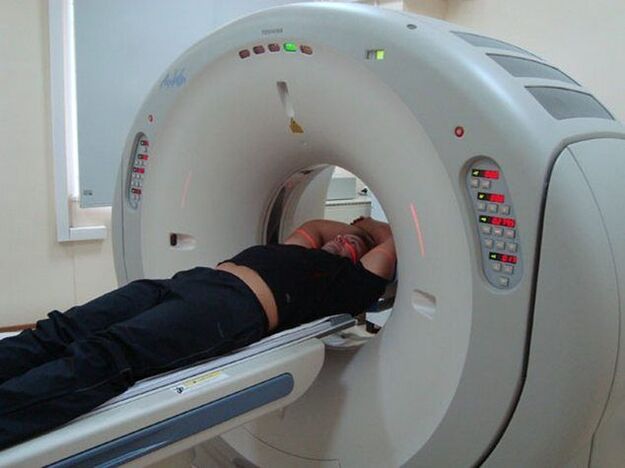
A neurologist makes a primary diagnosis based on the patient's complaints and medical history.During the external examination, it reveals points in the thoracic region that cause pain when pressed.Conducting functional tests allows you to assess the integrity of reflexes and identify sensitivity disorders.Of the instrumental methods, radiography is the most informative.But for a detailed study of the spine segment, CT and MRI can be done.In order to rule out diseases of the cardiovascular system, patients are prescribed an ECG.
First aid for exacerbation
Pain during a relapse of thoracic osteochondrosis can be acute and penetrating, so the person must be given first aid.He should be calmed down, put on a hard surface and covered with a warm blanket.If the relapse is accompanied by rapid heartbeat, shortness of breath or increased anxiety, then you must call a doctor.To relieve the pain between the shoulder blades, you can take any non-steroidal anti-inflammatory drug.
How to treat thoracic osteochondrosis
Only an integrated approach to treatment will allow you to get rid of all symptoms of osteochondrosis, slow down or completely stop its spread to healthy discs and vertebrae.For pathology of 1-2 severity, conservative methods of therapy are used.Grade 3-4 osteochondrosis is characterized by the formation of large hernias.To remove compression of blood vessels and spinal roots, surgical treatment may be required.
Drugs
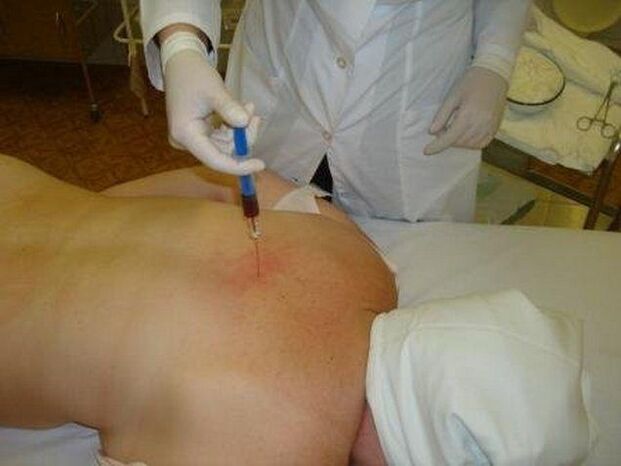
Medicines from different clinical and pharmacological groups are used in the treatment of thoracic osteochondrosis.In the initial phase, parenteral agents are usually used, which quickly have a therapeutic effect.After a few days, injection solutions are replaced by safer tablets, ointments and plasters.
Nonsteroidal anti-inflammatory drugs (NSAIDs)
NSAIDs have pronounced analgesic, anti-inflammatory and anti-edematous effects.Intramuscular administration of solutions allows relief of acute pain.In order to eliminate mild discomfort between the shoulder blades, products for local application are used.And moderate pain is well treated with non-steroidal anti-inflammatory drugs taken orally.
Muscle relaxants
Muscle relaxants are used to relieve muscle spasms that occur in response to severe pain.The most common treatment of thoracic osteochondrosis begins with the intramuscular administration of drugs, which, in addition to the muscle relaxant tolperisone, also include an anesthetic.
Chondroprotectors
In the case of pathology of the 1st degree of severity, a course of taking chondroprotectors helps to restore the damaged discs.In other cases, they are prescribed to improve the metabolism in the affected segment of the spine and prevent the progression of the disease.
Vitamin B preparations
Their use helps to increase blood flow, improve the work of the peripheral nervous system, restore trophism and innervation.B complex vitamins have a beneficial effect on degenerative diseases of the nerves and musculoskeletal system.
Therapeutic exercise
For thoracic osteochondrosis of the 1st degree, daily exercise therapy allows you to do without the use of drugs.Recovery occurs by strengthening the muscles and improving the blood supply of nutrients to the tissues.In other cases, exercise and regular training help prevent the involvement of healthy spinal segments in the destructive process and prolong the remission phase.
Complex from a standing position
In the standing position, the following therapeutic exercises are most effective:
- put your palms on your shoulders, lean forward, simultaneously lifting your bent legs, as if you are trying to reach the opposite knee with your elbow;
- Raise your left hand and bend to the right.Perform the exercise in the opposite direction;
- Place your feet shoulder-width apart and raise your arms.Lean forward, palm touching the opposite foot.
The number of repetitions is 10-12 times in 2-3 approaches.
From a lying position
To perform these exercises, you will need a gym mat or a thick blanket folded in half:
- lie on your stomach, raise your arms and legs at the same time;
- lying on your back, raise the upper part of the body, extend the palms towards the feet;
- lying on your back, bend one leg, pull it behind the other, trying to touch the surface of the floor with your knee.
Each exercise should be performed 7-10 times.
From a sitting position
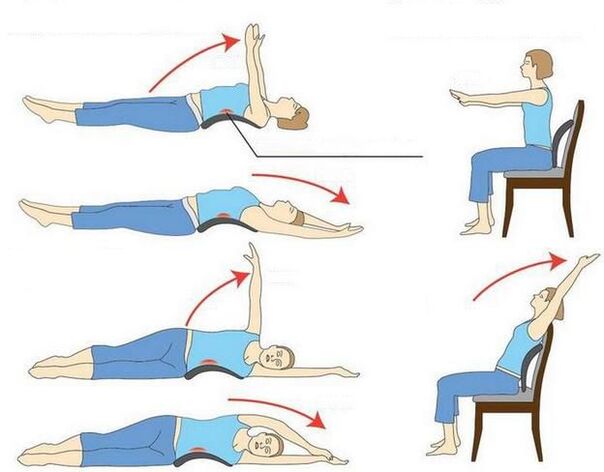
When performing such exercises, sudden movements of high amplitude, including twisting, should be avoided:
- sitting on the floor, stretch forward, trying to touch the opposite foot with your palm;
- sitting on a chair or stool, stretch your arms forward and slowly turn from side to side;
- sitting on the floor, grab your knee with your hands and pull it as close to your chest as possible.
During the first lessons, the exercises should be repeated 5-7 times, after about a month - 15-20 times.
Physiotherapy treatment
Magnetotherapy, laser therapy, UHF therapy, sinusoidal currents, shock wave therapy, paraffin and ozokerite applications are used in the treatment of thoracic osteochondrosis.During exacerbations, electrophoresis and ultraphonophoresis are performed with glucocorticosteroids, anesthetics, B vitamins and chondroprotectors.
Massage
A massage performed by an expert helps relieve pain between the shoulder blades and relax spasmodic skeletal muscles.

All types of massage are therapeutically effective for osteochondrosis - classical, vacuum, acupuncture, connective tissue.At home, self-massage can be practically performed using a wooden or electric massager with a long handle.
Acupuncture
Acupuncture is a method of treating pathology by inserting needles into bioactive points on the human body.They are thin and short, so when the skin is pierced, only mild discomfort occasionally occurs.But even such an effect is enough for the body to produce substances with analgesic and anti-inflammatory effects.
Food
Nutritionists recommend patients with thoracic osteochondrosis to avoid fatty meat, rich soups, dry meat, homemade and factory marinades.You should limit the amount of salt in your diet, which causes edema.Every day you should drink about 2.5 liters of liquid - water, vegetable juices, berry drinks, fruit compotes.
Folk remedies
Neurologists allow the use of decoctions and infusions of medicinal herbs, ointments, alcohol and oil rubs, poultices after the main therapy.Folk remedies are used to relieve mild pain between the shoulder blades, which sometimes occur after physical activity.
Celery root
Peel the large celery root, chop it on a fine grater, squeeze out the juice.Add 100 g of chopped fresh celery.Take 3 tablespoons up to 4 times a day with meals to clean the vertebrae from harmful salt deposits.
sunflower root
Pour a teaspoon of dry crushed sunflower root into a glass of hot water.Let it boil, cook on low heat for 20 minutes, cool under the lid, strain.Drink during the day in 3-4 doses.
Homemade grease

Grind a spoonful of gum turpentine and thick honey in a mortar, add 2 drops of juniper, rosemary and eucalyptus essential oils.Enter 100 g of medical petroleum jelly in small portions.Mix, transfer to a jar, store in the refrigerator, rub on the back for pain.
During pregnancy
Many systemic analgesics are contraindicated during pregnancy, so neurologists prefer products for external use - ointments, gels and patches.If you cannot do without taking pills, then their doses are significantly reduced.In the period of childbirth, the main methods of treatment of thoracic osteochondrosis are massage and exercise therapy.
Possible consequences
In the absence of medical intervention, thoracic osteochondrosis can cause pneumosclerosis, arrhythmia, vegetative-vascular dystonia, deterioration of the gastrointestinal tract, and impaired sexual and reproductive function in women and men.
Prevention and prognosis
The prognosis is favorable if the disease is detected in time and competent, comprehensive treatment is carried out.If complications of thoracic osteochondrosis have developed, then only following all medical recommendations will make it possible to achieve a stable remission.
In order to prevent the pathology, neurologists recommend excluding the factors that cause it from your usual lifestyle.These are excess weight, low physical activity, lack of vitamins and microelements, and excessive stress on the spine.